

College Boards And Committees
Board and Committee Structure of the College
The relationships between the boards and committees of the College can be illustrated as follows:
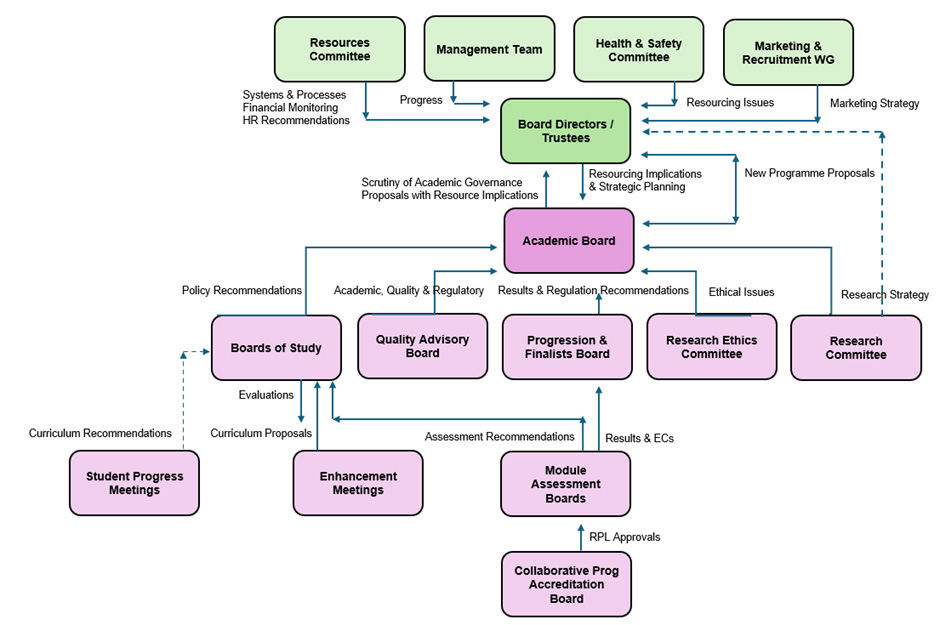
This structure and the membership of our Boards and Committees ensure that both College staff and students have substantial input into our decision-making processes. The Boards of Study and Academic Board have student representatives and student representatives are invited to contribute to (or attend, if they wish) the Health & Safety Committee. A student attends the Board of Directors/Trustees in the role of Student Voice. The Research Ethics Committee and Board of Directors have public interest representatives. The Academic Board is attended by an external academic advisor.
All formal meetings have formal agendas and are minuted. Some informal enhancement or management meetings are recorded with simple action points.
Student Representation
Each student cohort sends one representative to the Board of Study for their course. These meetings occur twice a year.
Student representatives from a range of courses attend Academic Board meetings.
In addition, student representatives for cohorts for practitioner training courses are invited to contribute to the annual Health & Safety Committee meeting and can attend if they wish.
The role of the student reps is to represent their cohort, or individuals within it, at these meetings.
Each student cohort will therefore elect one or two representatives. Although only one representative can formally attend any one Board of Studies meeting, the cohort may if they wish elect pairs of representatives, who can then share out the attendance at these meetings between them.
The Academic Board
Membership:
- The Principal
- The Course Directors
- The Acupuncture Clinic Director
- Nutrition Clinic Supervisor
- Herbs Clinic Supervisor
- Research Director
- The Registrar
- The Librarian
- Representation from the teaching staff (up to three members, at least one of whom also sits on a Module Assessment board)
- An external academic (one)
- Three or four student representatives (across a range of subjects)
The Principal chairs the meeting. The Registrar is secretary to the Board.
Duties
- To review and determine the approach to education and academic functioning of the College, including staffing, curriculum development, assessment and evaluation.
- To have overall and primary responsibility for the College’s academic regulations, policies and procedures.
- To maintain academic quality and standards of all NCA courses (final responsibility for externally validated courses rests with the partner University, final responsibility for courses that are not externally validated rests with the Academic Board).
- To review research standards.
- To review delegated risks from the risk register and report to Board of Directors/Trustees on any significant changes or concerns.
- To oversee the operation of quality assurance and enhancement at Course level, and to identify and monitor implementation of enhancement of teaching, learning and assessment at College level.
- To confirm that additions or revisions to academic regulations, policies and procedures are in accordance with the expectations and indicators of the QAA Quality Code.
- To ensure that all courses/programmes and their constituent modules comply with the FHEQ framework.
- To receive reports from the Boards of Study, the Assessment Boards, the Quality Advisory Board, the Research and Research Ethics Committees, University review committees and professional accreditation bodies.
- To receive reports from the Quality Advisory Board on their review of Annual Monitoring Reports, identifying good practice and enhancement opportunities at College level and referring good practice and enhancement opportunities at course level to the Board of Study for action.
- To oversee the nomination of all external examiners and to monitor their roles.
- To review the functioning of the teaching clinics.
- To arbitrate, at the final stage, probation and suspension procedures for academic matters.
- To monitor and review staff development.
- To monitor the College’s post-registration continuing professional development courses.
Relationship to Board of Directors/Trustees
The Academic Board is responsible for academic quality and standards, while the Board of Directors is responsible for ensuring that our provision aligns with our philosophy, charitable objectives and strategic priorities. With respect to academic governance, the Board of Directors/Trustees has an oversight role, to ensure academic governance is effective by working with the Academic Board to maintain academic and research standards, ensure enhancement of teaching, learning and assessment, and ensure that academic risks are effectively managed1.
Powers of Decision
The Academic Board is the final decision-making body on all matters of educational policy, the structure and organisation of courses, and teaching clinic policies. The Board works towards achieving a consensus wherever possible, but it has the power to make decisions on a majority vote, except where these affect prior understandings and commitments entered into by the College (for example with the University, professional accreditation bodies, the student body, college staff, etc.) Decisions on matters which have significant resource implications must be referred to the Board of Directors.
Frequency and Timing of Meetings
The Board meets three times a year.
Boards of Study
Membership
- Student representatives (for more information about being a student rep see below)
- Principal
- Module Leaders
- Partner Link Tutor(s)
- Northern College of Acupuncture Link Tutor (the Course Director)
- Course Director and other academic staff involved in the delivery of the course/programme and/or modules
- Student Services Manager/Officer responsible for the course/programme
The student representatives are elected by the end of week 4 to ensure that the interests of students on the course are represented. They are also responsible for feeding back the outcomes of any meetings or events they attend. Students can find out who the student reps are by looking on the VLE under College Information. Minutes of the meetings are uploaded to the course area of the Student Hub on SharePoint.
Duties
This is a forum where student representatives and staff meet to discuss the relevant course or programme, so there is a Board of Study for the BSc in Acupuncture, a different one for the MSc in Nutrition Science and Practice, a third Board of Study for the MSc in Chinese Herbal Medicine and a fourth (meeting by online video conferencing) for the MScs in Advanced Oriental Medicine and Advanced Nutrition. The agenda includes any issues but also talking about future developments and things that are going well. The Board also looks at student survey results and the reports from External Examiners and scrutinises the Course Annual Report for the Course/Programme. Minutes are made of the discussions and decisions, and you can read these online in the Course Documents in the VLE.
Terms of reference
The Board of Study aims:
- To control the day to day operation and management of the course and monitor the performance of the course and the student experience, in terms of:
- meeting students’ needs
- meeting University needs
- meeting Professional Body needs
- meeting College / staff needs
- achievements of students
- student experience of the course
- staff experience of the course
- To review the interrelationship of all aspects of the course to maintain overall course coherence.
- To initiate the appropriate action in the event of the identification of the need for change or development.
- To confirm that changes and developments to the course are in accordance with the expectations and indicators of the QAA Quality Code.
- To inform the Course Director’s Course Annual Report on an annual basis in line with University Regulations.
Frequency and Timing of Meetings
Meetings are held twice per academic year.
Student Progress Committee
The student progress committee process is focussed on concerns about a student’s well-being, development as a practitioner, and/or academic progress.
The welfare and progress of students is discussed at confidential meetings of the student progress committee, which is attended by the Course Director, Student Services, Module Leaders, and Clinic Director. The Course Director chairs the meeting and a Student Services representative takes the minutes.
Prior to the meeting the Course Director circulates all staff with a request that they share their concerns about any student in relation to their welfare, academic performance or development as a practitioner. At the meeting any information or concerns are raised, shared and discussed, and the Concerns about Students Record is reviewed and updated. Where personal matters are concerned and the student has raised them with a member of staff, the sharing of information is within the limits of confidentiality agreed with the student.
Arising from these discussions, it may be decided that there are concerns about the student’s welfare, development as a practitioner, or academic performance. The committee may decide to:
- Take no immediate action but continue to monitor the situation
- Delegate the personal tutor to speak to the student. The discussion with the student would focus on passing on the concerns, clarifying the nature of any problems and identifying appropriate support which could be offered by the College or by other agencies. When appropriate, the student should be encouraged to document the issues and any support needs in their Personal Development Plan (PDP). Support needs identified by the student in their PDP should then be fed back by the personal tutor to the Course Director so that these needs can be addressed by the College. If involvement of the personal tutor is impractical or inappropriate, another tutor, clinic supervisor, or the Course Director can be delegated to speak to the student.
Support available to students includes:
- One-to-one support by one of the study skills support tutors.
- The College’s confidential counselling service.
- More frequent sessions with the personal tutor.
- Support from other academic staff (particularly those involved in subject areas such as Practitioner Development).
In cases of concern about student welfare, the personal tutor must discuss with the student what information they consent to be disclosed to other staff. The personal tutor must then communicate this information to the Registrar, who will add it to the student record and disseminate it as appropriate to other staff (administrative, teaching and clinical).
In cases of concern about a student’s behaviour and/or development as a practitioner, as well as involving the personal tutor the committee will usually communicate the concern to the clinic supervisors, and to other teaching staff as appropriate.
The Health and Safety Committee
Members
- The Principal
- College Manager
The College Manager chairs the meeting. A College Administrator is secretary to the committee.
Prior to a meeting of the Health and Safety Committee the following are circulated with a request to alert the Committee to any issues they are aware of which need attention:
- Student reps from each cohort
- Course Directors
- Nutrition Clinic Supervisor
- Acupuncture Clinic Director
- Herbs Clinic Supervisor
Any of the above can attend a meeting of the Committee if they wish to do so, particularly if they have a serious concern or they think an important matter is not being adequately dealt with.
Duties
- To evaluate and develop current policy and procedures in all Health & Safety matters, utilising the differing perspectives of committee members, and to identify areas of concern, and areas in need of attention.
- To receive reports of risk assessments, to approve action required to remove/control risks and to determine that corrective courses of action are implemented.
- To provide recommendations to the Principal/Board of Directors as appropriate on all matters that relate to Health and Safety.
- To provide avenues of communication between students, staff and management on all Health and Safety matters.
- To provide an annual report to the Resources Committee, which in turn reports in summary to the Board of Directors/Trustees.
- To report urgent matters immediately direct to the Board of Directors/Trustees.
Powers of Decision
The committee works towards achieving a consensus whenever possible. It has the power to make decisions by a majority vote on matters which do not have significant resource implications, or amount to major policy changes.
Recommendations on matters with significant resource implications (more than £300) and major policy changes must be referred to the Board of Directors for approval.
Frequency and Timing of Meetings
This Committee meets twice a year. Meetings may be held by correspondence.
The Module Assessment Board
Members
- The Principal (Chair)
- The Student Services Manager or Officer
- Course Director
- Internal examiners - College module leaders
- External Examiner(s)
- HSU Partnerships Quality Manager
The Principal has been appointed Chair of the meeting by the HSU. The Registrar is secretary to the Board.
There is a separate Module Assessment Board for each subject area.
Duties
- To review all assessment results for all students, to ratify end of module marks, and to make recommendations to the Progression and Finalists Assessment Board.
- To make decisions on moderation of marks, where appropriate.
- Consideration of Extenuating Circumstances: The Module Assessment Board may review any extenuating circumstances affecting the assessment of candidates, arising from illness or bereavement or other relevant circumstances, and makes recommendations to the Progression and Finalists Board in light of the extenuating circumstances. Candidates who are aware that their work may have been affected by such circumstances must inform the Board of these circumstances in writing using the extenuating circumstances procedure and normally by five days after the submission date or exam date. All communications about extenuating circumstances with the Assessment Boards and with College staff are treated as totally confidential. Late applications for consideration of extenuating circumstances will only be considered when a justification for lateness is provided with evidence, and these late applications must reach the Chair of the Assessment Board before it meets. For details of these procedures the section below on Extenuating Circumstances.
- Review of Course: The meeting of the Module Assessment Board is also an important opportunity to monitor and review the course and the assessment procedures in the light of the presenting standards. Recommendations arising are normally referred to the Board of Study for the course.
- To report to the Academic Board on its decisions, in the form of a general report on passes and fails, and on recommendations on assessment policy. More detailed recommendations on assessment strategy can be made to the Board of Study for the course.
Powers of Decision
The Board works towards achieving a consensus whenever possible but has the power to make decisions by a majority vote.
The Progression and Finalists Assessment Board
Members
This Board is normally (when the agenda includes decisions on final awards) chaired by the HSU Partnerships Quality Manager or another HSU approved nominee. The membership comprises:
- HSU Partnerships Quality Manager (Chair)
- Principal
- Registrar
- All Course Directors
- Student Services Manager and Officer
- One or two of the external examiners (whose role is to ensure that due process is followed and to advise on decisions on matters such as extenuating circumstances).
- The College Services Assistant (secretary to the Board).
There is a Lates Board in September which receives marks for late submissions and resits, and there is a Research Projects Board in January. These Boards combine the functions of the Module Assessment Boards, in receiving marks and confirming overall module marks for students with late submissions and resits, with the Progression and Finalists Board. Members of these meetings are the same as listed above.
Duties
- Academic standing and awards: To receive all module marks determined by the Module Assessment Boards, to decide on the academic standing of students, including progression and if necessary the conditions for any referrals, and to determine final marks and make recommendations to the University on awards and qualifications.
- Consideration of Extenuating Circumstances: The Board may review any extenuating circumstances affecting the assessment of candidates, arising from illness or bereavement or other relevant circumstances, receives recommendations in relation to extenuating circumstances from the Module Assessment Boards, and makes decisions on progression and awards in light of these considerations. Candidates who are aware that their work may have been affected by such circumstances must inform the Board of these circumstances in writing, following the extenuating circumstances procedure and by five days at the latest after the submission date or exam date. All communications about extenuating circumstances with the Assessment Boards and with College staff are treated as totally confidential.
- Review of Policy: The Progression and Finalists Board also considers the implementation of assessment policy, regulations and procedures relating to the academic standing of students, and related matters of principle, and makes any recommendations arising to Academic Board.
Powers of decision
Decision on Awards:
- The Progression and Finalists Board makes recommendations to the validating partner on awards and grades. For details of the minimum criteria and grades see the assessment sections of this College Handbook and the Course Handbooks.
Reporting of Decisions:
- The Registrar of the Health Sciences University will be informed by the College of the progression decisions each year.
- The Conferment List confirmed by the Assessment Board must be signed by the Chair of the Progression and Finalists Assessment Board and by the External Examiner(s) appointed to the Board (wherever possible at the Board or within 7 days).
- The Registrar is responsible for passing the decisions of the Progression and Finalists Assessment Board (in the form of a Pass/Conferment List) direct to the Registry of HSU for the issuing of certificates. Certificates will be issued within 4 months from receipt of accurate and complete conferment lists. The Link Tutor should keep a copy in case of subsequent queries. All Conferment Lists should be completed clearly and in accordance with the published guidelines.
Authority of Assessment Boards
Assessment Boards derive their authority from Academic Board and are responsible for the assessment of students.
Voting
At a meeting of an Assessment Board every effort shall be made to reach a decision by consensus, taking into account the views of external examiners. If it proves necessary to vote on any matter it shall be determined by a simple majority; each member present shall have one vote and in the case of equality the Chair shall have an additional casting vote.
No recommendation for the conferment of a qualification, (other than undergraduate qualifications based solely on modules at levels 3 and 4), may be awarded without the written consent of the approved External Examiner(s). On any matter which the External Examiner(s) have declared a matter of principle, the decision of the External Examiner(s) shall either be accepted as final by the Assessment Board or shall be referred to the Academic Board. Any unresolved disagreement between External Examiners shall be referred to the Academic Board.
The Progression and Finalists Assessment Board has the authority to:
- compensate failure at marks of 35 – 40% in modules in accordance with the limits stated below.
- require a student to transfer to a different course of study, and/or permit a student to attempt additional credits as a condition of progression.
Compensation
Failure at marks of 35-40% in modules may be compensated, only in exceptional circumstances, at the discretion of the Progression and Finalists Board. It is subject to satisfactory overall performance, and is permitted for a maximum of 30 credits.
NOTES
- Any compensation should be taken in the context of a student’s extenuating circumstances, and should not normally be granted without such evidence.
- Compensation should not be agreed for project or dissertation modules.
- Compensation should not normally be granted where a student has not undertaken reassessment where such an opportunity existed.
- If compensation is granted in a module, the Progression and Finalists Board may require the student to change their course of study and/or transfer to another qualification.
- Compensation should not normally be granted unless there is strength in the student’s overall performance.
- Compensation will not be granted in modules which have been deemed “non-compensatable” in the course specification, due to their special contribution to the achievement of course learning outcomes, or due to professional requirements.
Compensated failure will count towards the total credit required for a qualification but will be indicated as such on a student’s academic record by the addition of a ‘C’.
A compensated failure will be treated as a pass mark for the purposes of classification profiling.
Quoracy
All members of Assessment Boards are required to give attendance at meetings of that Board priority over all other commitments. Apologies cannot be given – any absence has to be approved by the Chair. If for some exceptional reason a member of the Board is unable to attend a meeting, the Chair shall normally appoint a substitute.
A meeting of the Board, at which decisions to ratify grades and/or decisions on recommendations for the award of qualifications are made, shall not normally be quorate unless every external examiner or their properly appointed substitute is present. In exceptional circumstances this requirement may be waived, but only if an absent external examiner has provided all the information, reports and other written matter normally expected to be available at the meeting, and given an explanation for absence which the Chair has accepted as being unavoidable.
(Note: references to external examiners do not include undergraduate qualifications based only on modules at level 3 and level 4)
The quorum for Assessment Boards, for taught courses at every level, should be one third of the membership or four persons whichever is the larger. Attendance by substitutes who have not been involved in the relevant assessment process is not permitted in order to achieve quoracy. The Chair of the Board may declare a meeting of that Board inquorate should the Chair decide that the attendance is such as to jeopardise the soundness of the Board’s decisions.
All members of Assessment Boards should make known to the Boards to which they belong any personal relationships, or other potential conflicts of interest they have with any candidates whom the Board is assessing, other than those arising from their roles as tutors or administrators. Boards in receipt of this information should formally consider the question whether the member with the personal interest should absent themselves from all or part of the proceedings of the Board and the person concerned should abide by any decision on this matter taken by a properly constituted Assessment Board.
Delegation of functions
An Assessment Board may delegate any of its functions to the Chair or group of members. Any group operating with delegated powers shall report its proceedings to the parent Board at the next available opportunity. No recommendation for the award of a University qualification shall be made without the agreement of the appropriate external examiner (other than for undergraduate qualifications based on modules graded at level 3 and level 4).
Record of Proceedings
A record shall be made of the proceedings of the meetings of the Assessment Boards. It shall be circulated to the members of the Board. The confidentiality of individual students should be respected. This regulation shall not be so interpreted as to impede the work of an appeal panel.
The record of the Assessment Board shall include the minutes of the meeting and as separate items:
- the agreed marks/grades for each candidate;
- the recommendations made in respect of each candidate;
- the result of any vote
- a note that any claim for extenuating circumstances made by a candidate has been considered, whether or not the recommendation was affected
- the agreed decision on academic standing for each candidate
Any student who has been considered by the Assessment Board is entitled to see a copy of any items (a) to (e) listed above as they may apply directly to the student, by request to the Chair, no later than three years after the date of the Assessment Board.
General Discretion
An Assessment Board may exceptionally exercise discretion in a student’s favour, where it appears to the Board that strict interpretation of a particular assessment regulation would cause serious injustice to the student.
Whenever the Board uses this discretionary power to modify the interpretation of an assessment regulation an appropriate entry must be made in the Board’s minutes.
Interpretation of assessment regulations for courses of study
- Formal interpretation
- Formal interpretation of assessment regulations may only be made by the Academic Board. The findings of Academic Board are binding.
- Such formal interpretation by the Academic Board shall not be concerned with academic judgement, and shall be without prejudice to the authority of an Assessment Board, external examiners or any external awarding body.
- Academic judgement
- Where academic judgement is concerned, interpretation of Academic Board policy or regulations shall only be made by the Assessment Board acting collectively or, in exceptional cases where the Board delegates its authority, by the Chair of the Board.
- Informal interpretation
- Informal advice on the interpretation of Academic Board policy or assessment regulations by the Chair, Registrar or other member of staff shall have no formal authority and shall not commit the Assessment Board
Extenuating Circumstances
Extenuating circumstances (ECs) can consist of one or more personal difficulties such as ill health. A request, supported by acceptable evidence as required by the College, should be submitted by a student for these circumstances to be considered. ECs will be considered by Course Directors and if deemed necessary may be taken into account by Assessment Boards. ECs may lead to the allowing uncapped resit or resubmission, or in some circumstances Boards may consider compensation/condonement. ECs may also be taken into account in determining the classification of degrees and the progression of students. Extenuating circumstances will not normally include:
- proximity or number of examinations or other assessments
- pressure of work (except for exceptional employment commitments2)
- misreading of examination timetables
- poor time management
- scheduling of holidays or time abroad
General principles
- No student shall be put in a position of unfair advantage over other candidates; the aim should be to enable all students to be assessed on equal terms.
- All work submitted by students for assessment shall be graded on its merits without consideration of any extenuating circumstances known to the marker. Extenuating circumstances will not be used by Module Assessment Boards to alter the marks/grades of students, though they can make recommendations to the Progression and Finalists Board.
- Students must submit extenuating circumstances claims, following the procedures given in this Handbook, by the specified deadline.
- Extenuating circumstances will be considered by Assessment Boards in the following circumstances:
- in some circumstances compensation/condonement.
- in considering whether a student may progress to the next stage of the course
- in determining the classification for a qualification where the student is borderline or there are conflicting classifications in the profiles of grades
- in consideration for an aegrotat award.
- Normally extenuating circumstances shall not be taken into account where the circumstances have already been allowed for (for example, by special assessment arrangements and/or the implementation of a student support plan). Special assessment arrangements should be agreed at enrolment in cases of known disability and in any case agreed with the student before an examination period begins.
- Extenuating circumstances brought to the attention of the Chair of the Assessment Board after the Board or Committee has met should normally be considered only if the student was unable or, for valid reasons, unwilling, to disclose them before the meeting.
- The student’s extenuating circumstances will be reported to the Chair during the Assessment Board, noting what documentary evidence has been supplied. Access to the original evidence is restricted to the Chair, Student Support staff, the External Examiners of the Assessment Board, and the Registrar, for the purposes of assessment, unless the student declares otherwise.
- Only extenuating circumstances submitted directly by the student to the Student Services Manager/Officer responsible for their course will be recorded and considered. Tutors and other staff should advise students accordingly.
- Where a decision regarding ECs is made by the Assessment Board, consideration will be given to the full history of summarised extenuating circumstances. Where necessary the Chair or Secretary will obtain the original evidence from the Student Services Manager/Officer responsible for the course prior to the meeting. The extenuating circumstances may be taken into account as specified above, and it should be noted where this is used in determining the classification of the qualification awarded.
Guidelines and criteria for action
When the Progression and Finalists Board needs to consider extenuating circumstances they will wish to:
- note whether acceptable evidence has been supplied when requested;
- consider whether the student has performed unexpectedly badly in a given module or modules; whether there is a significant difference between the student’s performance in the year in which they experienced difficulties and their previous or later performance; and whether it correlates with the evidence provided;
- consider whether, where extenuating circumstances are judged to be very severe and it is not possible for the student to undertake further assessment, an aegrotat degree (which is without classification) be awarded. A student, or authorised representative, must signify acceptance of an aegrotat award within three weeks of notification, and if so accepted waives any right to reassessment.
External Examiner(s)
Based on recommendations of the College, one or two external examiners for each course are appointed by the validating partner for a four year period. The function of the External Examiners is to:
- serve as members of the Module Assessment Board and attend its meetings (one external examiner also serves as a member of the Progression and Finalists Board and attends its meetings),
- scrutinise samples of students’ assignments and examination papers across the range of marks, and scrutinise all work which has been recommended for first class/distinction grades or recommended for failure by the internal examiners,
- comment on the content and form of all assessments, the appropriateness and effectiveness of the internal assessment processes, regulations and procedures, the desirability of any recalibration or (exceptionally) remarking of assessed work, and the appropriateness of the standards against which the assessment process has taken place.
- approve draft examination papers prepared by the internal examiners
- ensure that academic standards are consistently maintained,
- assist the Board on final assessments and grades
- advise on the development of the course.
- adjudicate in cases referred to them because of disagreement between internal examiners
- assist in the development of a body of case law based on the discretion exercised by examiners under the approved assessment regulations of the College
- To submit annual reports as required by the validating University
- To inform the Principal separately from the normal annual report of any matter which in their view militates against the maintenance of appropriate academic standards and quality.
The External Examiners have oversight over the whole range of the course and they ensure that all aspects of the course are assessed to a consistent standard. They receive examination papers in advance for review, and receive samples of students’ work with the internal examiners’ marks and comments for all summative assessments. They also scrutinise all dissertations with the internal examiners’ marks and comments. The External Examiners provide the validating partner with an overall report on the standards of the course, advise on any improvements or modifications that may be beneficial to the course and recommend appropriate areas for action.
External moderation is required for all assessments contributing to an award, based upon a representative sample of work as negotiated between the external examiner and Course Director. Usually the outcomes of moderation will inform practice for future assessments. However, if the external examiner is unwilling to confirm that the marking of an assessment is fair and of an appropriate standard, changes can be made to the marks of the student cohort. Changes may not be made exclusively to marks within a representative sample. Where the external examiner is unwilling to confirm that the marking is fair and of an appropriate standard, based on the sample, the assessment in question for the entire cohort should be re-marked. This might be through scaling up or down, should the sample be considered to be consistently over or under-marked, or a full re-mark if the pattern of error is inconsistent.
Rights of External Examiners
- To make recommendations for amendments to draft examination papers, or set additional examination questions in consultation with the appropriate internal examiner(s).
- To see any assessment material relating to the modules concerned; particularly, but not exclusively, to see any scripts, coursework, project reports, design, artefact or similar material relating to the assessment with which they are specifically associated, and, where appropriate, clinical experience or similar reports. To meet the students being assessed only where appropriate.
- Where assessment by coursework or continuous assessment forms part of the approved examination arrangements, to choose their own sample of scripts for assessment at final or key intermediate stages.
- To approve a student’s choice of project, individual study or dissertation included in the final stage of study.
- To require and be involved in the oral (viva voce) examination of any student, including specially arranged oral examinations where these are not required by the regulations as part of the standard assessment procedures.
- To be fully involved in decisions:
- reached by the assessment board following a request for review by a student, where it has been agreed to settle the request informally
- made by the assessment board following the upholding of requests for review via the appeals process
- reached by the assessment board following the recommendation of the Academic Board on interpretation of regulations
Appointment of external examiners
External examiners are appointed to Assessment Boards by the validating partner following recommendation by the Principal. External examiners shall normally be appointed no later than the start of the academic year in which they take up their appointment. External examiners are not normally involved in the assessment of modules at levels 3 or 4, or qualifications based solely on those modules.
The method of appointment, rights and responsibilities of external examiners are set out in HSU’s Academic Quality Framework, which can be viewed on-line at this link.
Procedures for when external examiners refuse to consent to the decisions of an Assessment Board:
Where an external examiner refuses to sign the confirmation form to agree the grades or the award of qualifications of the Board, the chair of the assessment board must report every case, including a full explanation of the circumstances, as soon as practicable to the Registrar and the validating partner. The chairs of assessment boards must, at the same time as they make any such report, complete a form specified for the purpose indicating the reason why the external examiner(s) declined to sign the confirmation form, and naming the student or students whose disputed assessment outcome resulted in such refusal. The outcomes of students not named in a report must not be prejudiced or delayed.
Internal Examiners
The responsibilities of internal examiners include the following:
- To attend all meetings of the Assessment Board of which they are a member and to give attendance at such meetings priority over all other commitments. If for some exceptional reason an internal examiner is unable to attend a meeting, they must seek approval of absence from the Chair and they shall normally propose a substitute for appointment by the Chair of the Board.
- To submit assessment material, including scripts, coursework or project reports to the external examiner(s) as required.
- To ensure that the mark sheet for the module(s) of assessed work for which they are responsible, as moderated (where applicable) by the external examiner and, where appropriate, the assessed work itself, is available to the Assessment Board by an agreed date.
- To hold themselves readily available for consultation during the first thirty minutes of the examination(s) for which they are responsible, or to arrange for a substitute to do so.
Assessment responsibilities
It is the responsibility of the College (through the Student Services Manager/Officer, Principal, Course Directors, Registrar, Module Leaders, assessment tutors and other staff):
- To ensure that internal examiners are aware of the implications of assessment regulations for the modules of assessed work for which they are immediately responsible, and that these regulations are fairly applied;
- To ensure that adequate notice of the details of assessment arrangements is given to each student;
- To advise students who find themselves in difficulties about their rights or obligations under the assessment regulations, and to inform students, when necessary, about the range of options open to the Board in a particular case where the regulations allow discretion to the Board;
- To investigate any cases of alleged injustice in the assessment of students, and to ensure that such cases are dealt with fairly by internal examiners (excluding matters of academic judgement);
- To ensure that students notifying adverse academic personal or medical circumstances are not unfairly disadvantaged and that the Assessment Board are fully informed of any known circumstances which might affect the Board’s decisions on assessment;
- To ensure that any special arrangements for the assessment of students with disabilities are provided as agreed;
- To decide, subject to confirmation by the Assessment Board, what calculators or other aids may be brought into the examination room;
- To ensure that a report is made to the Assessment Board of any incident of academic misconduct;
- To ensure that deadlines for the submission of projects, essays and other written work are fairly applied
- To keep a record of receipt of assessed work submitted and to make these available to the Assessment Board as required;
- To ensure that papers set for students being reassessed are appropriate for the course of study as taught to them and that they have access to appropriate facilities to prepare themselves for the paper set for them;
- To arrange oral (viva voce) examinations as required by the Assessment Board;
- To ensure that students are given adequate advice and guidance on the full range of choices available to them under the assessment regulations;
- To be responsible for the investigation of claims of eligibility for aegrotat awards and to ensure that such claims, together with supporting evidence, are brought to the attention of the Assessment Board;
- To ensure for any given assessment, in any given module that composite grades/marks for each student are generated from the component grades/marks in a consistent and transparent way
Senior Management Team Meetings
Membership:
Principal
Course Directors
College Manager
Marketing and Admissions Manager
Finance Manager
Student Services Manager
Remit:
- 1. To review key strategic issues and the team actions necessary to address them
- 2. To review action plans which are the team’s responsibility, such as the DAPs action plan, and the Staff Induction and Development Plan
- 3. To work together to find solutions for management and administrative problems
- 4. To share information among team members to enable effective working together
- 5. To review learning from outcomes of complaints processes and from feedback from staff and students, and identify corrective or preventative actions
- 6. To review delegated risks from the risk register and report to Board of Directors/Trustees on any significant changes or concerns.
The Senior Management Team reports to the Board of Directors/Trustees
Research Ethics and Advisory Committee
Membership:
The NCA Research Ethics and Advisory Committee (REAC) comprises five permanent members:
- Research Director (Chair)
- Acupuncture Research Module Leader
- Chinese Herbal Medicine Research Project Module Leader
- Nutrition Science and Practice Research Project Module Leader
- Online MScs Research Project Module Leader
The REAC may consult and/or invite to a meeting relevant external advisors and research supervisors (particularly those with experience of ethics processes elsewhere in HE).
The REAC is a sub-committee of the Academic Board, which appoints members to it. The REAC reports to the Research Committee.
The Chair is responsible for checking the REAC inbox on a regular basis, alerting the remaining REAC members to any urgent issues, and signing-off on any appropriate Variations to Ethical Approval.
Remit:
The purpose of the REAC is to ensure that any research studies undertaken by students or staff at NCA are:
- 1. designed and conducted in ways that meet NCA’s ethical guidelines,
- 2. are of benefit to the profession and its client group,
- 3. do not represent any risk or issue to the College or to the reputation of the therapy in question,
- 4. generally are consistent with the reputation of the NCA and its approach to education and healthcare.
In addition, the REAC has an advisory function. When REAC scrutiny of a research proposal raises concerns about quality, e.g. in relation to research design, these concerns will be communicated in confidence to the research supervisor, to assist them in their supervision of the research project.
All research studies carried out by students MUST be given NCA REAC approval in order to continue, notwithstanding any other ethical approval given by any other medical research ethics board.
In order to determine the ethical validity of research proposals from students and staff, the REAC will observe the following:
- Whether or not all participants in the research (including the researcher) are adequately informed about processes and undertakings, and are given the opportunity to give explicit and informed consent;
- Whether or not all participants in the research (including the researcher) are adequately protected from any harms, including psychological harms, that could reasonably be anticipated;
- Whether or not all vulnerable groups are adequately identified and provided with any special provisions necessary for their safe participation;
- Whether or not people or resources are being used responsibly;
- Whether or not the motivation for a project is ethically acceptable. This includes consideration of the proposed degree of activity and whether or not it is commensurate with the desired end;
- Whether or not the proposed research is adequately referenced to previous research;
- Whether or not, taking into account all aspects of the proposal, it represents good science;
- Whether or not there are aspects of the research design that may be relevant to ethical considerations (for example, research should not be designed as to potentially yield meaningless results, thereby wasting participants’ time and hopes);
- Whether or not a project represents a risk or an issue to the College. Such risks will be reported to the Research Committee, which will in turn report the risk upwards to the Academic Board. The risks will be managed by the REAC on behalf of the Research Committee.
For secondary research, the REAC serves as a project approvals committee. In these cases, the committee functions to approve projects that are sufficiently well designed to be likely to succeed, and to refuse projects whose flawed design is likely to lead to failure. This is to help students to avoid undertaking projects that are deemed likely to fail at the assessment stage, and to avoid the danger of publication of ‘bad science’, which may have the potential to mislead.
The REAC also:
- 1. considers the validity of claimed exemptions to the data sharing policy regarding raw data from students’ research projects, notifying outcomes back to the student, and reporting these onwards to the Research Committee;
- 2. considers the validity of applications for Variations in Ethical Approval, notifying outcomes back to the student, and reporting these onwards to the Research Committee.
The REAC carries out two other functions on behalf of the Academic Board.
Firstly, the REAC puts forward regulations and guidelines for the maintenance of an appropriate research ethic at NCA. Specifically, these regulations and guidelines cover:
- Informed consent;
- Potential risks to patients;
- Confidentiality and ownership of results;
- Inducements to participate in trials;
- Restrictions on experimentation.
Secondly, the REAC reports to the Research Committee, which in turn reports to the Academic Board, as issues of principle and practice arise.
The REAC may, at its own discretion, consult with the Ethics Committee of our validating partner on any specific ethics issues arising, and may choose, at its own discretion, to act on guidance given.
REAC process
The REAC members between them provide REAC confirmation for student Part A ethics applications (those with lower ethical risk and less complexity, as determined by the Part A self-assessment form) that have been signed off by the supervisor. The members who are not involved in the student’s course will share confirmation between them.
The REAC members will also provide REAC oversight for any Part B ethics applications on a similar basis.
Advisory comments on research proposals will be communicated in confidence by the REAC to the research supervisor.
Frequency of meetings
The RPMLs will meet to discuss matters arising and any REAC business, on the following proposed schedule:
Once a month from November to January inclusive (3 x monthly meetings)
After that, by correspondence.
These meetings will normally be for two hours but may be for longer if need arises.
The intention here is to avoid a situation where a student’s project work is delayed by a long wait for the next REAC meeting.
Statement on supervisor interest
The NCA REAC is a small committee, and of necessity its members are also dissertation supervisors. For lack of enough members with appropriate skills to review ethics applications, it may sometimes happen that REAC members are called on to review their supervisees’ ethics applications. It may also happen that REAC members are present while their supervisees’ ethics applications are being discussed.
In such cases, REAC members are required to:
- 1. Be aware of their own interest in a given dissertation, and to monitor their own bias either in favour or against its ethics provision;
- 2. Recuse themselves as necessary from reviewing an application, if they feel their bias is insuperable;
- 3. Respond to the ethics application entirely on the basis of information contained within the application form and the supporting DRP, irrespective of any other knowledge they have regarding the student’s intentions or additional work in progress;
- 4. Respect the opinions and decisions of the REAC as a whole, and particularly any other reviewer who has co-responsibility for deciding on the outcomes;
- 5. Abide by the Chair’s decision, which is final.
Restrictions on Experimentation
The following procedures must not take place on NCA premises without the express permission of the REAC:
- Therapeutic, surgical or investigative clinical trials;
- Single-dose therapeutic or investigative trials;
- Administration of a medicinal product as part of a teaching exercise;
- Procedures involving sensory deprivation;
- Hypnosis; and
- Administration of alcohol to human participants.
The following restrictions are in place:
- The taking of blood samples other than by finger-prick is restricted to a Registered Medical Practitioner or qualified phlebotomist.
- Participants must under no circumstances certify that they are medically fit to take part in any experiment, procedure or demonstration.
- Maximum oxygen intake (VO2 max) tests may be taken as an indicator of physical fitness for endurance events only.
- Products other than prescribed drugs must have manufacturer’s licence and a copy must be provided to the REAC.
- Standard dosages complying with BNF guidelines must be used, and the committee will seek advice before any derivations are agreed.
- The NCA does not condone the use of animals for experimental research. Therapeutic treatment of animals may be considered, where allowed in law, as long as adequate steps have been taken to ensure animal welfare.
- The fact that the participant signs a form of consent should not obviate any of these rules.
Protection of participants’ rights
All volunteers have the right not to participate in any procedure, experiment or experimental teaching exercises or research. This right must be respected. If students are volunteers, they must be assured that any decision not to participate will not prejudice in any way their academic progress. Each volunteer should have the right to withdraw from the study at any time without penalty.
The following groups must not participate unless agreed in advance with the REC:
- Any person over whom the researcher has disciplinary or supervisory control;
- Students whose academic progress (exams or coursework) is in the hands of the researcher.
There must be no net financial gain for participating in the procedure, although reasonable expenses are allowed.
Volunteers must provide written consent to participate in the study. In the case of a minor, consent should also be provided by a parent or responsible adult.
The volunteer must be informed, in writing, of all the details of the research; in particular if it is anticipated that participants might be caused any distress either mental or physical by taking part in the research. If this is anticipated, it must be demonstrated that adequate measures will be provided to care for the participants. This should be highlighted in advance to the REAC.
Research Committee
Membership:
The Research Committee comprises: The Principal (Chair), The College Services Assistant (minutes), Research Director, MSc Research Project Module Leaders, BSc Acupuncture Research Module Leader, the Librarian, an external academic with a research background or a research supervisor.
Remit:
- To review and oversee the research strategy for the College, including aims and prioritised objectives.
- To facilitate, encourage and advise on research activities within the College.
- To work with the Research Ethics Committee to ensure that research is ethical and consistent with the objectives of the College.
- To encourage an understanding of research as part of the everyday life of the College, which informs and improves clinical and educational practice.
- To encourage ethical collaboration with other research organisations in pursuit of the research strategy.
- To make decisions on the allocation of specific funds for student research and publication of research.
The Committee reports to the Academic Board, which approves the research strategy. The Research Committee also reports verbally to the Board of Directors.
The Research Ethics Committee reports to the Research Committee on issues, challenges and dilemmas that arise.
The student representative leaves the meeting if there are issues to discuss which involve reviewing the progress of individual students. When necessary, these form Part Two of the meeting.
Frequency of meetings
The Research Committee meets at least twice a year.
Resources Committee
Membership
The Resources Committee comprises: one or two Directors/Trustees (usually those having oversight of finance and HR issues), the Principal and the Finance Manager.
Remit
- Consider financial and resource implications of strategic issues and report to the Board.
- Review and develop policies, systems and processes for financial and personnel management.
- To review delegated risks from the risk register and report to Board of Directors/Trustees on any significant changes or concerns.
- Scrutinise regular budget monitoring accounts, comparing actual and budgeted figures, and report to the Board.
- Discuss issues relating to personnel and facilities, including premises, IT and other equipment, and make recommendations to Board.
- Prepare draft budget annually and propose to Board.
- Meet with auditors annually, and more often if necessary, to review finances.
- Review pay policy annually and propose changes to the Board.
- To report to the Board of Directors/Trustees.
Frequency of meetings
The Resources Committee meets at least four times per year, approximately two weeks prior to meetings of the Board of Directors.
Marketing and Recruitment Working Group
Membership
The Marketing and Recruitment Working Group comprises the Marketing Manager, Marketing Officer some Trustees/Directors (usually those having oversight of marketing and recruitment issues), Principal and IT Officer.
Remit
- Review the annual marketing strategy, for approval by the Board of Directors/Trustees
- Discuss any marketing and recruitment issues as necessary, drawing on the expertise of the members to provide advice and guidance to the Marketing Manager
- Receive reports on current marketing activity in line with the marketing strategy
- Receive reports on current recruitment status
- Identify any areas of concern that may need to be raised with the Board of Directors/Trustees
- Monitor and steer the progress of the marketing strategy against agreed metrics
The marketing and recruitment working group reports on its actions, monitoring and decisions to the Board of Directors/Trustees.
Frequency of meetings
The Marketing and Recruitment Working Group meets approximately three weeks before meetings of the Board of Directors.
1Including partnerships and collaboration, recruitment and retention of students, provision of information, quality assurance and research integrity.
2These include sudden crises at work, or unanticipated overtime or travel