
Policy and Guidance on the Use of Generative AI
|
Version: |
0.1 |
|
Policy Owner: |
NCA Registrar |
|
Effective from: |
1st September 2026 |
1.Scope and Purpose
1.1. NCA recognises that generative AI writing tools can be a valuable tool for learning. These tools can assist students in their background reading and in coursework by answering specific questions, and they can be a support in structuring essays and laying out effective written communication. It is understood that students will engage with AI, and the purpose of this policy is to support effectiveness and transparency in using generative AI. The guidance provided in this policy can also help students to avoid infringing the academic regulations.
1.2. This policy and guidance applies to all work undertaken by all NCA students in the course of their degree. It particularly applies to formative and summative assessments.
1.3. This policy should be read in the context of the NCA Academic Integrity and Academic Misconduct Policy.
2. Introduction, context and definitions
2.1. Generative AI software is defined within this policy as any software application which is able to respond to a given question or prompt with a ‘tailored’ response.
2.2. For the purposes of definition, generative AI will also include:
- any software that substantially changes the meaning and material of a student’s work while rendering it in grammatical or fluent English. This includes, for instance, Grammarly Premium.
- “AI humanisers” and paraphrasers that make originally AI-generated text appear as human writing, such as TextGuard and QuillBot.
- AI summaries generated by search engines in responding to a search.
2.3. NCA distinguishes between AI use for learning and AI use for assessment. Within environmentally responsible limits, the College supports the use of AI to support thinking, explore ideas, develop understanding and become “AI-ready” for the workplace and their own future clinics. AI use in assessment is subject to specific rules that vary by module; it must always be disclosed.
2.4. There are many reasons why students should be wary of generative AI. For example:
- Generative AI will always answer a prompt, and the answer may appear plausible or fluent, but the answer may be inaccurate, made-up (“hallucinated”), incomplete, plagiarised (unreferenced), biased or even offensive. Students should not be misled by the plausibility of a response into thinking that a response is fit for purpose.
- There is a growing body of research demonstrating that use of AI results in atrophy of critical thinking skills and independent learning. These are essential elements of any degree and particularly relevant to both acupuncture training and life in practice. Substantial use of AI therefore essentially devalues the degree in which students are investing time and money.
- Generative AI has an environmental impact that students may wish to consider in their use of these tools, specifically with reference to the British Acupuncture Council Educational Standards S3 requiring acupuncturists to practise in an environmentally responsible manner, which may be extended to the use of AI during acupuncture training and study.
- Generative AI is essentially retrospective – developers use banks of material to train the types of generative AI software used by the public and students – and therefore content is based on the past rather than the present, which makes it difficult to produce the original or innovative work required for high marks, particularly at Levels 5 and 6.
- AI embodies and reproduces the biases of existing material. This includes cultural, geographical, gender and racial distortions of reality, which, when perpetuated through AI use, can help to embed these inequities in an AI-based society.
3. NCA’s approach to AI in student work
3.1. NCA adopts a careful and justifiable level of generative AI in teaching, learning and assessment, congruent with higher education frameworks, professional standards and regulatory body requirements, and the College’s own institutional values.
3.2. No student will be required to use AI unless they are taking a module that includes mandatory use. Concerns regarding AI use, whether on personal, ethical or other grounds, will be respected as far as possible within the limits imposed by the requirements of these modules. Work is always assessed on its own merits and the use or non-use of AI (where permitted) in an assessment will not affect marks per se.
3.3. In all use, students should apply criticality to AI outputs, applying triangulation and verification. In this way, we aim to increase our students’ effective AI literacy and their independent learning and critical thinking skills, alongside the development of subject knowledge.
3.4. Students are offered training on AI each year to support appropriate use and develop their literacy. While this training is offered as extra-curricular provision, students are strongly advised to dedicate some of their self-study hours to completing the training each year. Links to the training can be found in the AI Materials repository on SharePoint.
3.5. Understanding what is expected from an assessment brief is a core academic skill and this includes understanding expectations regarding AI. Acceptable AI use varies by assessment, and it is the student’s responsibility to establish what is permitted before commencing work. For every assessed piece of work, the module descriptor will provide an indication of permitted or required AI use, following the traffic light system; if the student is unclear whether their use of AI is permitted, they should contact the Module Leader or the Course Lead to clarify.
3.6. AI use that breaches this policy may constitute academic misconduct and will be handled under the provisions of the NCA Academic Integrity and Misconduct policy. The Academic Integrity and Misconduct policy also provides for the consideration of breaches of this Use of Generative AI policy as matters of Fitness to Practice. For the avoidance of doubt, breaches include, but are not limited to:
- Submitting AI-generated work, or a proportion of AI-generated work, as one’s own where this is not permitted or required;
- Using AI to complete assessments, including take-home exams, in ways explicitly prohibited in the assessment brief;
- Failing to disclose AI use that has materially contributed to submitted work.
3.7. Students who are concerned about AI use, uncertain about what is expected of them, or feel that their relationship with AI tools is becoming problematic, are encouraged to contact the relevant Module Leader, the Course Lead or Student Support. NCA will not take a judgemental stance on past AI use, and will seek to support the student as far as possible to manage the issues in the future. However, this will not include checking or providing opinions on whether AI use is appropriate.
Permitted AI use
3.8. The traffic light system set out in Section 4 below gives a high-level outline of permitted use of AI in relation to assessments. However, even when an assessment is classified as Red (i.e., no AI use in the assessment) students may still use AI in the following ways:
- Background research. This can be defined as prompting AI to provide summaries or information relating to terminology or concepts that are unfamiliar to the student. In this way, AI is similar to the use of a textbook. Output must always be checked for accuracy and relevance, and must never be directly reproduced in the body of an assessment.
- Brainstorming and exploring ideas. This can be defined as a development of the above point, where ideas are explored in greater depth.
- Planning or structuring work. Use of AI may help to structure an assessment or help a student understand the necessary elements or steps in completing a task. However, students must always preserve any structures given in the module descriptor or teaching, and remain aware that any structures/plans produced by AI must only be reproduced in secondary or indirect form in the assignment itself (i.e., do not copy and paste a structure or plan generated by AI).
- Basic proofreading, e.g. basic grammar, spelling and punctuation (including Word or basic Grammarly) is permitted. AI use that substantially changes sentence construction or meaning is not permitted (see Non-permitted AI use, below).
- Revision (including making virtual quizzes, flip cards etc), reading a text aloud.
- Summarising to assess relevance. Students may use AI to make a summary to assess the relevance of a resource.
- These examples are provided as illustrations and are not exhaustive. If students are in any doubt about their use of AI in a given context, they are advised to contact the Course Lead for advice.
Non-permitted AI use
3.9. As a general rule, generative AI must not be used to author all or any part of the text or images of any assessment (including formative assessments) unless expressly permitted by the module descriptor and/or in-class teaching. Using AI in this way is similar to passing off the work of another as your own (plagiarism), and may be interpreted as academic misconduct. This means that:
- Generative AI content cannot be directly reproduced (i.e., copied/pasted) in an assessment, unless the assessment explicitly requires or permits this to be done as part of the assessment methods. Teaching/learning and guidance will be provided to assist students in these cases.
- Generative AI cannot be rephrased/rewritten and incorporated into an assessment.
- Generative AI cannot be used to paraphrase or summarise text (for instance, where the text is over length and requires shortening) or to edit the text of an assignment for other purposes, including improving academic English. These are key academic writing skills, and the extent to which students can exercise these skills is part of the assessment criteria for many assessments; under this policy, the use of generative AI to achieve these ends is therefore regarded as academic misconduct.
- These examples are provided as illustrations and are not exhaustive. If students are in any doubt about their use of AI in a given context, they are advised to contact the Course Lead for advice.
Use of AI in the teaching clinic
3.10. AI may be used in the student clinic, just as any other clinical aid may be used (for example, medical dictionaries or medicines databases). If AI is used in this way, it must always be declared to the supervisor during the discussion of treatment. The supervisor and the student must discuss the AI output and decide whether AI suggestions are appropriate for the patient. Where no discussion takes place (for example, for third-year students in their final clinic days; or where there is no discussion for lack of time), students must not base a treatment on AI content, but instead use their own knowledge and training.
3.11. Inappropriate use of generative AI in the teaching clinic may be defined as undeclared and undiscussed AI use in formulating any part of a treatment for any patient. This may constitute not only academic misconduct, but a risk to patients, and as such is regarded as a severe breach of the student’s duty of care towards a patient. Students suspected to be using AI without declaration and discussion will be reported by the supervisor to the Clinic Director, and may be subject to the procedures in the NCA Academic Integrity and Academic Misconduct policy, with additional possible Fitness to Practice measures as defined in the Academic Integrity and Academic Misconduct policy.
3.12. Use of AI in the teaching clinic should follow the guidelines set out in the Professional Standards Authority’s document Artificial Intelligence: How to guide and regulate for health and social care professionals who use AI.
3.13. At the time of writing (August 2026), the College’s professional standards and regulatory body (The British Acupuncture Council) is developing guidelines for AI use in clinical practice. When available, this policy will be revised to incorporate those guidelines.
Records of AI use
3.14. Where generative AI is used to assist with any formative or summative assignment, students are strongly advised to keep a record as a demonstration of responsible usage. NCA provides a template (GenAI record sheet v2.docx) which can be found in the AI Materials repository on SharePoint, but students may keep their own records as long as they incorporate the following information:
- Name, course, year
- Name and version of generative AI software used
- Assessment for which generative AI is being used
- For each individual prompt, including refinements of prompts:
- Date
- Text of prompt
- Exact copy of output generated
- Where students are using AI with voice prompts, or receiving output as voice, video or graphics, it is good practice to store these on their OneDrive and incorporate links in their record sheet. All links should be stored in accordance with the NCA’s student research data retention process (retention for 5 years after confirmation of award).
3.15. Where module descriptors state that generative AI is required as part of an assignment (see The traffic light system, below), students must supply an Appendix to their work comprising the records of their use. For this, they are recommended to use the NCA GenAI record sheet as linked above.
4. The traffic light system
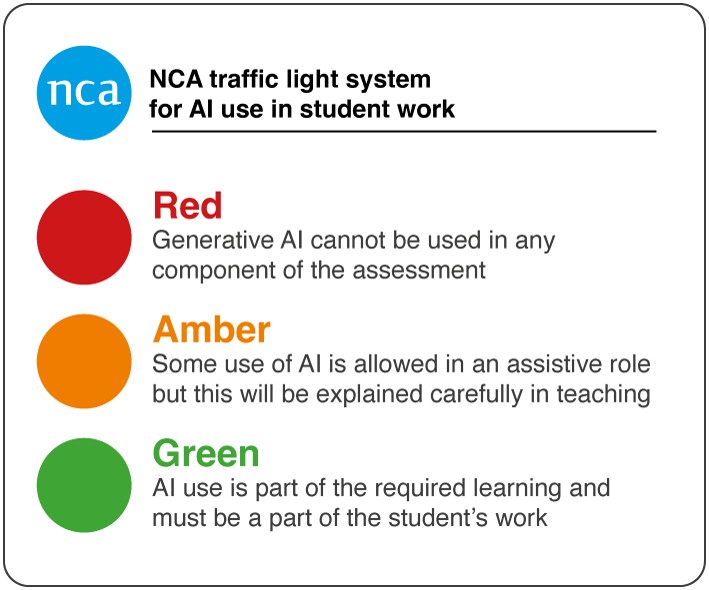
4.1. All NCA assessments are given a “traffic light” which indicates the level of AI use permitted in the assessment. These can be found in the module descriptor, and are reproduced below.
4.2. Examples of assessment types to which Red traffic lights may apply:
- Examinations, including tests and take-home exams
- Viva voce (oral) exams
- Clinical skills assessments
- If appropriate, proof-reading software is permitted, e.g., for minor grammar, spelling and punctuation corrections (but not for editing or paraphrasing text). For example, a dyslexic student who uses a laptop to write into a Word document in exams.
- However, in preparation for these types of assessments, students may use AI for assistive functions, such as revision as suggested under item 5 of paragraph 3.8 above.
4.3. Examples of assessment types to which Amber traffic lights may apply:
- Some written assessments such as essays
- Assistive roles may include those listed under paragraph 3.8 above.
- In such cases, students must keep records of their AI use, as per paragraphs 3.13 and 3.14 above.
4.4. Examples of assessment types to which Green traffic lights may apply:
- Some written assignments such as dissertations
- Required use will be explained and demonstrated in class.
- In such cases, students must keep and submit as part of the assessment, records of their AI use, as per paragraphs 3.13 and 3.14 above.
4.5. In any assignment that carries a Green traffic light, an Amber traffic light also applies – in other words, students may use AI in assistive functions such as those outlined in Section 3.8 above. In such cases, students must keep and submit as part of the assessment, records of their Amber AI use, as per paragraphs 3.13 and 3.14 above.
5. Declarations of AI use
5.1. Transparency in relation to AI use is a core expectation, in line with NCA’s institutional values and expectations of students. Where AI has been used in the preparation or production of assessed work, this must be declared in the submission.
- For work submitted via Turnitin, the current version of the Assignment Front Sheet must be used. This asks the student to make various declarations on their use of AI in their submitted work. Guidance on how to complete the front sheet can be found on SharePoint, along with the front sheet itself. Students are expected to complete the front sheet fully and honestly; failure to disclose AI use that has materially contributed to submitted work is a breach of academic integrity, irrespective of whether the use itself is permitted in the assignment.
- For work which does not use a front sheet (for example, work submitted for formative feedback, or clinical skills practical assessments), AI use should be declared in the accompanying email, or verbally to the assessor, as appropriate. Students are expected to adhere to this practice: failure to disclose AI use that has materially contributed to submitted work is a breach of academic integrity, irrespective of whether the use itself is permitted in the assignment.
6. Investigation of suspected inappropriate AI use
6.1. The process for identifying suspected inappropriate AI use is:
- Teaching teams will monitor assessments using their subject knowledge, academic judgement and training. Appropriate AI use for any submission is defined in the module descriptor.
- Where inappropriate AI use is suspected, a second marker (also a subject expert with training) will look at the work to provide a second opinion. If the second marker validates the opinion of the first marker, the work will be forwarded to the Course Lead for a third opinion, including (amongst other checks) the use of multiple AI detection tools.
- AI detection tools are unreliable and will never be used as the sole means of identifying inappropriate AI use.
6.2. If it is decided that there are reasonable grounds to suspect inappropriate AI use, investigation process and outcomes will follow the NCA Academic Integrity and Academic Misconduct policy.
7. Advice and support on using this Policy and Guidance
7.1. Advice and support on using this policy is available from Student Services and the Course Lead.
8. How we collect and process personal data under this policy
8.1. The nature of matters dealt with under this policy will often require the collection and processing of sensitive personal information. This information will be used for the purposes of implementing this policy only and will be kept in accordance with the College Records Retention Policy which requires records to be kept for 6 years after the last action on the case.
|
Version: |
0.1 |
|
Approved by: |
Academic Board |
|
Originator/Author: |
BSc Acupuncture Course Lead |
|
Policy Owner: |
NCA Registrar |
|
Date approved: |
27 August 2026 |
|
Effective from: |
1st September 2026 |
|
Review date: |
1st September 2027 |
|
Target: |
All staff and students |
|
Policy location: |
Policy Vault, SharePoint |
|
Reference Source: |
Council of the Deans of Health (2026). Principles for the use of Generative AI in healthcare education. HSU Library & Learning Services (2026). AI Literacy. HSU Library & Learning Services (2026). AI: Ethical considerations. HSU (2023). Use of ChatGPT and other Open AI writing tools at UCO Policy and Guidance, v2. (Cited here for completeness, but policy appears not to be available publicly at the time of this v0.1 policy publication HSU (nd). AI use best practice guidance. JISC Artificial Intelligence (2026). AI and Environmental Sustainability. Professional Standards Authority (2026). Artificial Intelligence: How to guide and regulate for health and social care professionals who use AI. University of York (2023). Student Guidance on Using AI and Translation Tools. University of Leeds (2026). Category of assessments. |