Orthopaedic Acupuncture
With Anthony Von Der Muhll
Dates: Saturday 31st October and Sunday 1st November
Times: 10am to 5pm

Day One: Orthopaedic Acupuncture for the Cervical Spine
Clinical anatomy, kinesiology, and the jing-jin ("sinew meridians" or myofascial tracts)
- Bones, muscles, discs and facet joints, and neurology
- Posture and motion dysfunctions
- The arthritic progression: strain/sprain, derangement, degeneration
History-taking for neck: key diagnostic questions
- "Red flag" symptoms of urgent/serious medical conditions warranting referral to physician care
- Differentiating symptoms of muscles, joint, disc, and spinal cord, plexus and nerve root injuries
- Neural hypersensitization and psycho-social factors
- Functional capacity questionnaires for reporting to managed care insurance
Physical exam of the neck: key procedures
- Observation, inspection and palpation
- Joint exam: active range-of-motion, stability, and tracking assessment of the cervical and thoracic spine and TM joint
- Neurologic exam: upper motor neuron; arm reflex, sensory, and motor function; and brachial plexopathies
- Documentation of physical exam findings
- Measuring and reporting functional capacity baselines and treatment outcomes
Diagnosis and pattern identification
- Cervicogenic and tension-type headaches
- Cervical and thoracic sprains/strains and chronic myofascial pain
- Cervical and thoracic disc and facet joint injuries: dysfunction, derangement, degeneration
- Nerve root and spinal cord injuries
- Intercostal sprains/strains
- Brachial plexopathies and thoracic outlet syndrome
- Myofascial trigger points and referred pain patterns for over 17 muscles of the head, face, neck and thorax
Treatment of neck pain and injuries
- When and how to use distant and local needling for rapid and lasting pain relief
- Electroacupuncture for neural blockade and rehabilitation
- Releasing muscle tension through myofascial trigger point needling
- Using 3-edged and lancet needles to reduce inflammation and ischemic pain
- Manual therapy: gua sha, tui na, and muscle energy techniques to reduce trigger points and restore muscle flexibility and joint range of motion
- Active suction cupping: combining cups with passive and active movement for rapid and lasting results
- Postural and ergonomic correction and exercise therapies
Day 2: Orthopaedic Acupuncture for the Shoulder Girdle
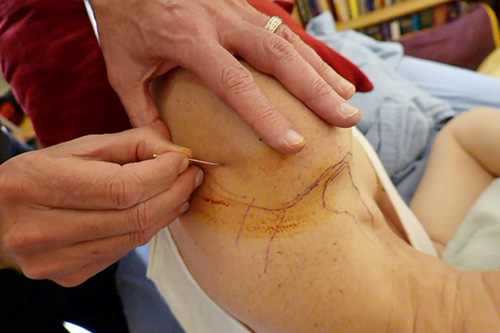
Clinical anatomy, kinesiology, & the jing-jin ("sinew meridians" or myofascial tracts)
- Glenohumeral, acromio- and sterno- clavicular joints
- Muscles, tendons and ligaments of the shoulder girdle
- Shoulder bursae
History-taking for the shoulder: key diagnostic questions
- "Red flag" symptoms of urgent/serious medical conditions warranting referral to physician care: fractures, dislocations and complete tears; neuropathies; tumors
- Differentiating symptoms of muscle, tendon, ligament, labral, capsular, and nerve injuries
- Neural hypersensitization and psycho-social factors
- Functional capacity questionnaires for reporting to managed care insurance
Physical exam of the shoulder: how findings can guide treatment with acupuncture modalities
- Observation, inspection and palpation
- Joint active range-of-motion and tracking exam: taking measurements and diagnostic significance
- Assessment of joint stability through end-feel testing
- Muscle length and manual strength testing and referred pain patterns charts for 18 key muscles of the shoulder girdle
- Special orthopedic tests
- Documentation of physical exam findings
- Measuring and reporting functional capacity baselines and treatment outcomes
- Clinical flow charts to facilitate efficiency and accuracy in examination
Diagnosis, pattern identification and treatment for shoulder girdle pain, injuries and disability
- Gleno-humeral joint
- Non-capsular patterns: AMBRI and SLAP (labral) tears
- Capsular patterns: osteoarthorosis, capsulitis, and "frozen shoulder"
- Acromio- and sterno-clavicular joint sprains/separations and hypermobility
- Rotator cuff tendonitis/tendonosus, impingement, and bursitis
- Bicipital tendinopathies
Session Preview
Please watch this free webinar Anthony has provided to preview his upcoming session: Click here to access the webinar recording.
Cost
Full price (single day): £170
Full price (both days): £320